





Welcome to Day 8 and the start of Week 2. If you made it through last week — kitchen counters, nightstand, junk drawer, dresser, entryway, coat closet, and living room surfaces — I hope you’re already feeling the cumulative effect of everything we’ve cleared and reset together. Seven spaces in seven days is something genuinely worth celebrating, and the momentum you’ve built is real.
This week we’re moving into some of the most personal and functional spaces in the home. And we’re starting with your home office desk.
Your Desk Is Where Your Ambitions Live
Here’s what I think about the home office desk that makes it feel different from every other space we’ve tackled so far: it’s where your work happens. For those of us who work from home — and especially for moms who are building something alongside everything else that motherhood asks of them — the desk is one of the only spaces in the entire home that belongs entirely to you. It’s where you show up every day to create, to build, to think, to do the work that matters to you.
When it’s cluttered and disorganized, that work feels harder than it should. There’s a real and documented connection between a cluttered workspace and a cluttered mind — it’s harder to focus, harder to feel inspired, and harder to do your best work when the surface in front of you is crowded with things that don’t belong there. Most of us have simply gotten used to working around the mess without realizing how much it’s costing us.
What a Well-Edited Desk Actually Looks Like
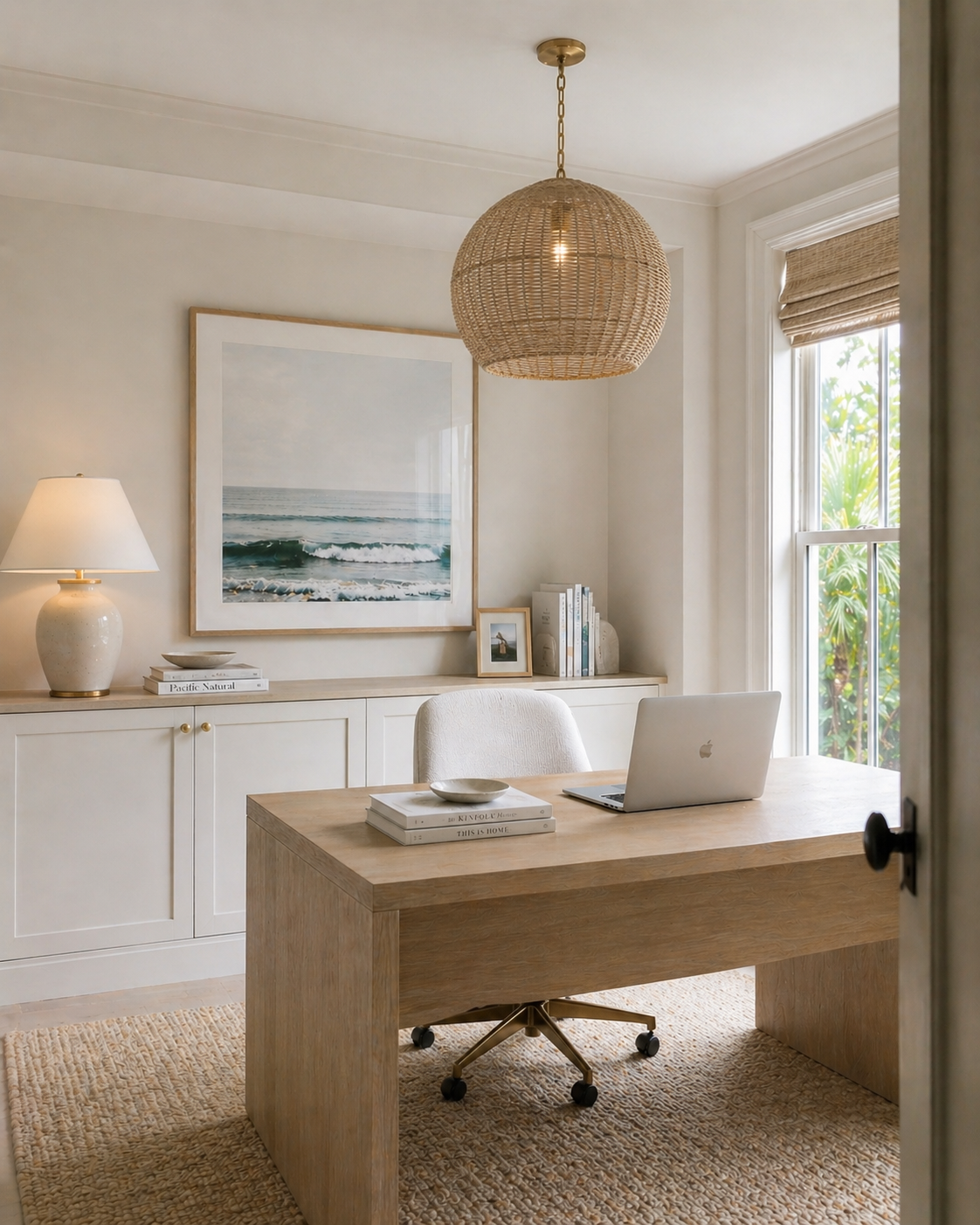
The most productive and beautiful desks tend to have very few things on them — and everything that’s there has earned its place. Here’s a simple framework for thinking about what genuinely belongs on a desk surface:
Your computer or laptop, obviously. A notepad and a pen or two that actually work. Any tools you reach for every single day — a planner, a charger, a specific item that’s essential to your workflow. One small, beautiful thing that makes you happy when you sit down — a candle, a small plant, a vase with a single stem. And ideally, clear space around all of it so your eyes have somewhere to rest and your mind has room to think.
What doesn’t belong on a desk is everything that has drifted there from other parts of your home and your life — the mail, the random objects, the things in transition, the items that landed on the desk because it was the nearest flat surface. None of those things are helping you do your best work.
How to Declutter Your Home Office Desk Today
Give yourself 20 to 30 minutes for this one. Put on something good to listen to and enjoy the process.
Step 1: Clear everything off completely. Every single thing comes off the desk — including your computer if you can manage it. Starting from a completely blank surface is the only way to make honest decisions about what goes back. It also gives you a chance to see the desk itself, which is something most of us genuinely never do.
Step 2: Clean the surface thoroughly. Wipe down every inch of the desk — the surface, the edges, the legs if they need it. Clean your monitor or laptop screen. Dust your keyboard. This step takes just a few minutes and makes a significant difference in how the finished space looks and feels. A clean desk is an inviting desk.
Step 3: Sort everything into keep, relocate, and let go. As you go through everything that came off the desk, sort honestly. The keep pile is for things that genuinely belong on a desk and get daily use. The relocate pile is for things that belong somewhere else in the house — the book that wandered in from the living room, the item that belongs in a drawer rather than on the surface. The let go pile is for things that are worn out, outdated, or simply no longer serving you.
Step 4: Organize what’s going back. Before anything goes back on the desk, think about how you actually work. What do you reach for first thing in the morning? What needs to be immediately accessible and what can live in a drawer? Organize with your real workflow in mind rather than what looks good in theory. The most beautiful desk organization systems are the ones that work for the person sitting at them.
Step 5: Return only what belongs. Place back only the items that genuinely earn their place on your desk surface. Give each one a specific, consistent home so it always goes back to the same spot. Consistency is what keeps the desk clear naturally over time without requiring constant effort.
Step 6: Add one thing that makes you happy to sit down. A candle you love, a small plant, a beautiful pen cup, a framed photo — one considered, personal thing that makes your desk feel like yours. Your workspace deserves to feel as intentional and lovely as the rest of your home. You spend a lot of time here. Make it worth sitting down at.
What Tomorrow Morning Will Feel Like
Tomorrow when you sit down at your desk to start your day and the surface in front of you is clear and considered and ready — when there’s nothing to navigate around, nothing pulling at your attention, just space and intention and the work you love — I hope you notice how differently you feel.
A clear desk doesn’t just look better. It changes the quality of your thinking, the ease of your focus, and the way you show up for the work that matters to you. That’s worth every minute of today.