




Welcome to Day 20 of 30 Spaces in 30 Days. Twenty spaces in twenty days, and today’s is one of the most personal and joyful ones in the entire challenge. Today we’re talking about Ollie’s toy storage. And I want to start by sharing the philosophy behind how we’ve approached this, because I think it’s the most important part of everything that follows.
Every Room Is Hers Too
When we set up Ollie’s play spaces, the guiding principle was simple: Ollie deserves to feel completely at home in every room of our house. Not just in a designated playroom, not just in her bedroom… in every room. The living room, the sunroom, the kitchen, the hallway. Everywhere.
That meant making sure her things were visible, accessible, and genuinely integrated into our home rather than tucked away out of sight. It meant hanging book ledges at her height so she can reach her books independently. It meant keeping a small collection of toys in baskets beneath the living room coffee table so she has something to reach for wherever she is. It meant designing her play spaces around her — her scale, her independence, her sense of ownership over the home she lives in.
A child who feels at home everywhere in her house is a child who feels genuinely secure and welcome. And that matters so much more than a perfectly tidy home.
How Ollie’s Play Spaces Are Set Up
I want to share the specific pieces and approach that have worked beautifully for us, because I think the details are genuinely useful.
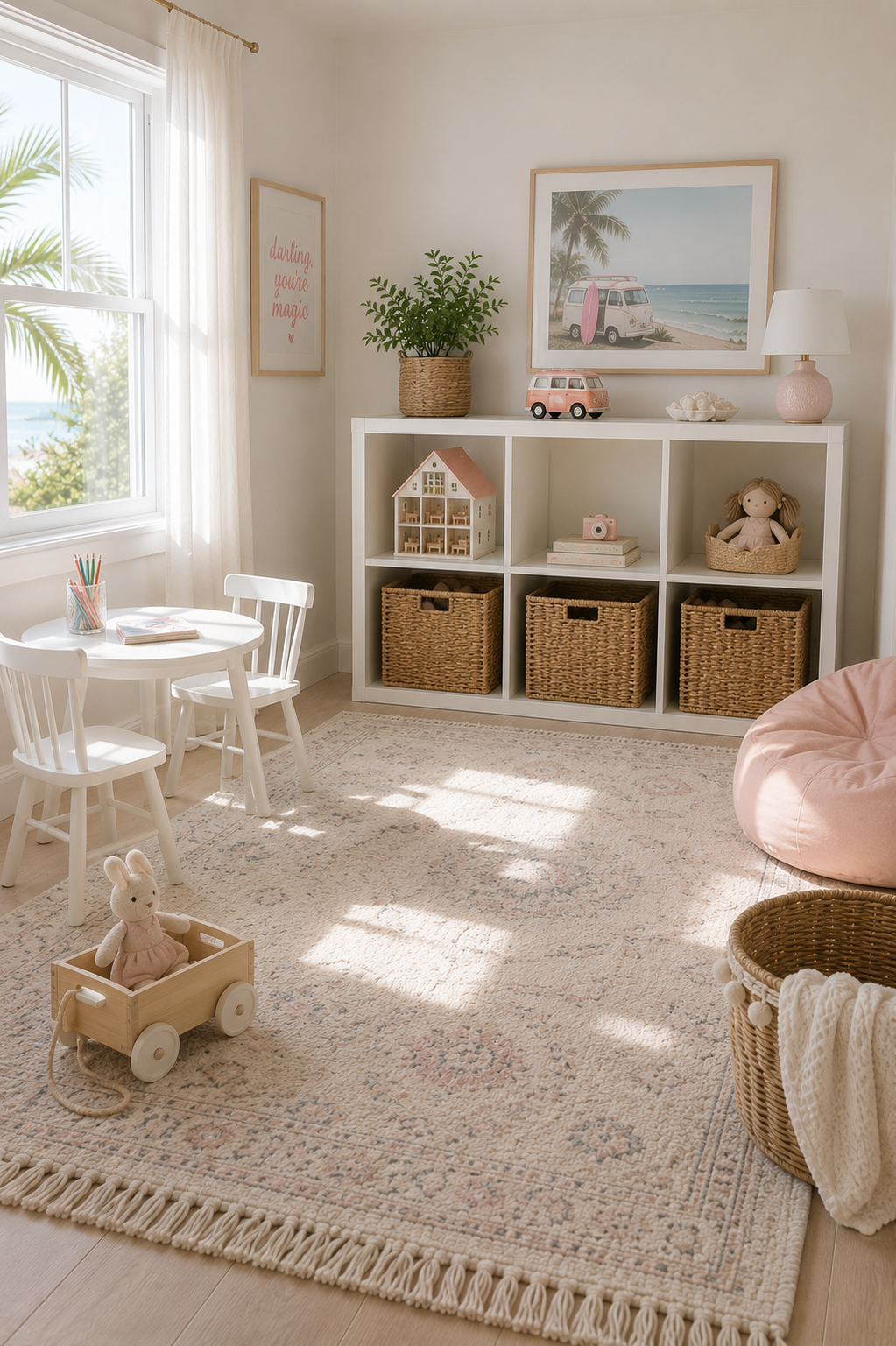
The Playroom is Ollie’s main play space, and the heart of it is the Dillon Low Bookcase from Pottery Barn. We chose it specifically because it keeps all of her toys visible — nothing is hidden in bins or behind closed doors. When toys are visible, children can make independent choices about what they want to play with. Ollie walks in, sees everything she has, and chooses based on what she’s genuinely drawn to in that moment. Her playhouse lives in here too, along with floating book ledges hung at her height so she can reach every single book completely independently.
The Sunroom has the Carolina Grow With You Activity Table from Pottery Barn Kids — a beautiful, functional play table with storage drawers underneath that keep everything she needs for that space right where she uses it. It’s a dedicated creative space that she loves.
Her Bedroom has floating bookshelves and a reading nook that she completely adores. Having books accessible in her room means reading happens naturally and independently — she reaches for them because they’re there and because they’re hers.
The Living Room has a small, curated selection of toys in baskets beneath the coffee table. This is one of my favorite details in our whole home — it means Ollie always has something to reach for in the room where our family spends the most time together. She doesn’t have to go to the playroom to find something to play with. She’s right there with us, at home, in the middle of everyday life.
The Sunday Toy Rotation
One of the best things we’ve done for Ollie’s play is toy rotation. Every Sunday, I rotate the toys that are available in Ollie’s play spaces. Some go into storage, others come out. The selection stays curated and fresh, which means Ollie approaches her toys with renewed curiosity and engagement at the start of each week. Something she hasn’t seen for a few weeks feels genuinely new and exciting when it comes back out — and the rotation keeps play from feeling stale or overwhelming.
It also means the play spaces stay manageable. When everything is out all the time, nothing feels special. When a smaller, intentional selection is available, children engage more deeply and more imaginatively with what they have. The Sunday rotation takes maybe 15 minutes and makes a meaningful difference in the quality of Ollie’s play throughout the week.
What Today’s Declutter Actually Looks Like
For today’s space, the approach is a little different from most of what we’ve tackled in this challenge — because toy storage for a toddler is less about ruthless editing and more about intentional curation. Here’s how to think through it:
Step 1: Do a full toy audit. Go through every toy in every play space and be honest about what Ollie actually plays with versus what just takes up space. Toys she hasn’t touched in months — regardless of how much they cost or how much you hoped she’d love them — deserve to be donated to a child who will actually use them.
Step 2: Think about visibility. Are Ollie’s toys visible and accessible, or are they buried in bins she can’t see into? Visible toy storage is genuinely one of the most effective things you can do for independent play — when a child can see their options, they make choices. When they can’t, they either ask for help or disengage entirely.
Step 3: Hang books at her height. If you haven’t already done this — picture ledge shelves like these from Wayfair hung at toddler height are one of the most wonderful small investments you can make. When books are at her level, reading happens independently and naturally. It’s one of those details that makes a real difference in a child’s relationship with books.
Step 4: Consider a toy rotation. If your child’s play space feels overwhelming or if they seem disengaged with their toys, a rotation is worth trying. Store half the toys out of sight and rotate on a weekly or biweekly basis. The renewed engagement is immediate and genuinely remarkable.
Step 5: Make every room feel like hers. A small basket of toys in the living room, a book ledge in her bedroom, her snack shelf in the pantry — small gestures throughout your home that say to your child: you belong here too. These details cost very little and mean everything.
Step 6: Involve her in tidying. At two and a half, Ollie is more than capable of putting things back where they belong — especially when everything has a clear, visible, consistent home. Toy storage that makes sense to a child is toy storage that a child can maintain. Keep it simple, keep it accessible, and let her be part of the process.
A Home That Belongs to Her
The best thing about the way we’ve set up Ollie’s toy storage isn’t any individual piece or system. It’s the feeling it creates — for her and for us. She moves through our home freely, confidently, knowing that her things are where she left them and that she has a place in every room.
That’s what we wanted for her. And watching her navigate her home with that kind of ease and ownership is one of the quiet joys of this season of parenting.