



Welcome to Day 15 and the start of Week 3 of 30 Spaces in 30 Days. If you made it through the refrigerator yesterday, today’s space is the natural next step — and a quieter, more forgotten one.
The freezer doesn’t ask much of you. It just hums along in the background, doing its job, while things accumulate inside it at a pace so gradual that you genuinely stop noticing. Until one day you open it and realize there are things in there you have absolutely no memory of putting in. That’s the freezer. And today we’re finally dealing with it.
The Most Forgotten Space in Your Kitchen
Unlike the refrigerator, which you open multiple times a day and see constantly, the freezer gets visited less frequently and with more purpose. You open it, grab what you came for, and close it again. Which means everything else in there — the things you didn’t come for — just stays. Week after week, month after month, quietly accumulating.
The smoothie ingredients you bought with enthusiasm and forgot about. The leftovers you froze optimistically and never defrosted. The mystery containers with no label and no identifiable contents that have been in there long enough that opening them feels like a genuine risk. And — in our case and I suspect in many of yours — an inexplicable collection of ice packs that have multiplied quietly over the years until they have somehow taken over an entire shelf?!
How does this happen? Nobody knows. But today, we’re tackling your freezer!
What a Well-Stocked Freezer Actually Does for Your Family
Here’s what I genuinely love about a well-organized freezer: it becomes one of the most useful tools in your kitchen. When you know exactly what’s in there — when everything is visible, labeled, and intentionally stocked — the freezer stops being a mystery and starts being a resource.
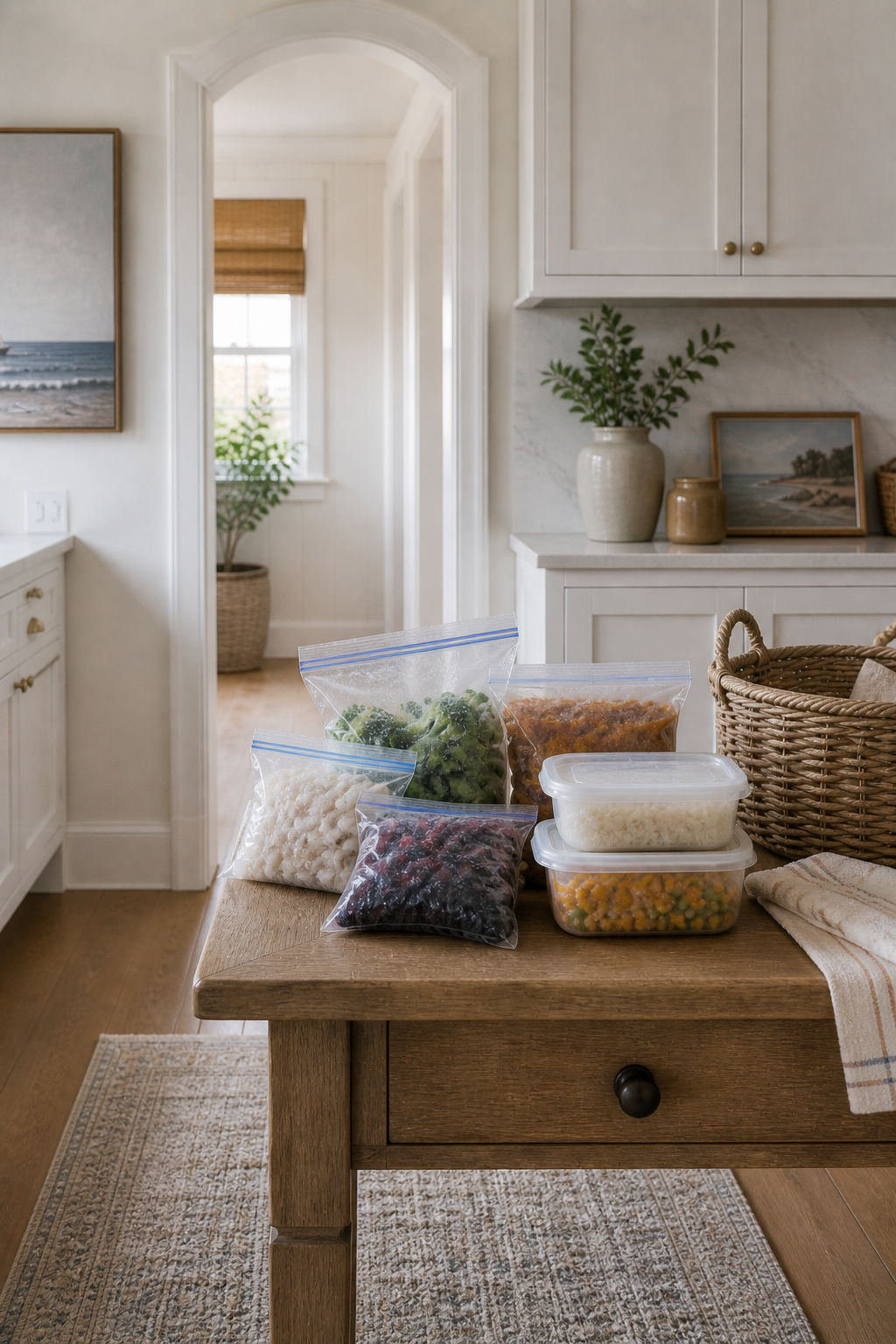
In our home, the freezer does real and daily work. My frozen smoothie ingredients live in there for my morning routine — grabbing them quickly and easily every day depends entirely on them having a consistent, accessible home. Our frozen vegetables are a family staple that we reach for regularly, and knowing exactly what we have and what needs restocking makes grocery shopping so much more straightforward.
When the freezer is cluttered with things that don’t belong or things you’ve forgotten about, all of that becomes harder. Today we’re clearing it out so it can do its job properly.
How to Declutter Your Freezer Today
Give yourself 30 minutes for this one and work quickly — you don’t want everything to defrost while you’re sorting.
Step 1: Pull everything out. Work quickly and efficiently. Lay everything out on your counter so you can see exactly what you’re working with. Have a bin or a cooler nearby for items that need to stay cold while you work.
Step 2: Wipe the freezer down completely. Before anything goes back in, wipe down every surface — the shelves, the door, the walls. A clean freezer is a genuinely motivating thing to restock intentionally.
Step 3: Check every item honestly. Frozen food doesn’t last forever, and freezer burn is real. Go through everything and be honest — anything with significant freezer burn, anything unidentifiable, anything you genuinely cannot remember freezing or have no plan to actually use goes. If it has a label with a date, check it. If it has no label and no identifiable contents, let it go.
Step 4: Deal with the ice packs. Pull them all out, decide how many you actually need, and donate or discard the rest. Be honest and be decisive — this is not a category that benefits from keeping just in case.
Step 5: Sort what’s staying into categories. Before anything goes back in, group like with like. Smoothie ingredients together, frozen vegetables together, proteins together, prepared meals together. Sorting first makes putting things back so much more intentional.
Step 6: Label everything going back in. If you’re putting anything unlabeled back in the freezer today — leftovers, meal prep, anything without a clear package — label it before it goes in. A small piece of masking tape and a marker takes ten seconds and saves you from the mystery container situation six months from now.
Step 7: Return everything with intention. Put each category back in a designated spot. Your most-reached-for items — the smoothie ingredients, the everyday frozen vegetables — go in the most accessible spots. Less frequent items can live further back. Give everything a consistent home.
Step 8: Note what needs restocking. Before you close the freezer, make a note of anything that’s running low and add it to your grocery list. A freezer declutter is one of the best opportunities to get genuinely clear on what your family actually uses and what deserves to stay stocked.
A Freezer That Works for You
There’s something quietly satisfying about a decluttered freezer — not the immediate visual gratification of a cleared coffee table or a freshly reset entryway, but a deeper, more practical satisfaction. The knowledge that you know exactly what’s in there. That nothing is being forgotten or wasted. That when you open that door, you’ll find what you came for without having to move twelve ice packs to get to it.
That’s what today is about. A freezer that actually works for your family — efficiently, clearly, and without the archaeology. See you tomorrow for Day 16 — kitchen cabinets!